
Power and Horses (2) – Symbols of Authority
In the previous episode and this one, we explore this theme of “power and horses.”
Our stage this time is the Japanese imperial court.
One pillar of the imperial court’s authority was to carry out age-old rituals in the proper form, without interruption.
Diplomatic ceremonies, court rituals, and shrine festivals—
From antiquity through the medieval era, the imperial court used horses at key moments to make its authority visible.
From the fifteenth century on, however, constant warfare left the capital in ruins.
The imperial court fell into financial hardship, and even the most essential rites—such as enthronements and abdications—were often postponed or omitted.
It was a crisis that shook imperial authority itself.
It was in this climate that, in 1574 (Tenshō 2), the traditional horse race(Kurabeuma)at Kamigamo Shrine was held.
Traditionally, the horses were supplied from estates donated by the imperial court.
But in that year, the shrine turned for help to Oda Nobunaga (1534-1582) , whose power was rising across the five central provinces around Kyoto.
The shift spoke volumes: it signaled a turning point for the era.
Seven years later, at the imperial court’s request, the grand imperial horse parade(Kyoto Ouma-zoroe)was held.
Ōta Gyūichi’s The Chronicle of Lord Nobunaga (Shinchō kōki) records the following:
Through imperial envoys, the emperor praised Nobunaga, saying, “There is no entertainment more fascinating than this. I am truly satisfied.”
People of all ranks likewise felt that it was “an age of peace,” and that it was “a spectacle they would never forget.”
Barely a year later, Nobunaga lost his life in the Honnō-ji Incident.
The full restoration of the imperial court—the hope of Emperor Ōgimachi (1517-1593) and Prince Sanehito (1552-1586)—may never have been fulfilled in their lifetimes.
Even so, on the day they took such delight in the magnificent imperial horse parade that Nobunaga staged at the court’s request, the age-old horse rituals of the imperial court may have sprung back into dazzling life in their minds, if only for a moment.
In the main video, we examine the imperial horse parade from the perspective of the imperial court, drawing on paintings and historical sources produced around the period in which it was held. In our spring series, we explored “Power and Horses” through Oda Nobunaga’s lens.
We take care to read primary sources closely.
If you’re interested, we invite you to watch those videos as well.
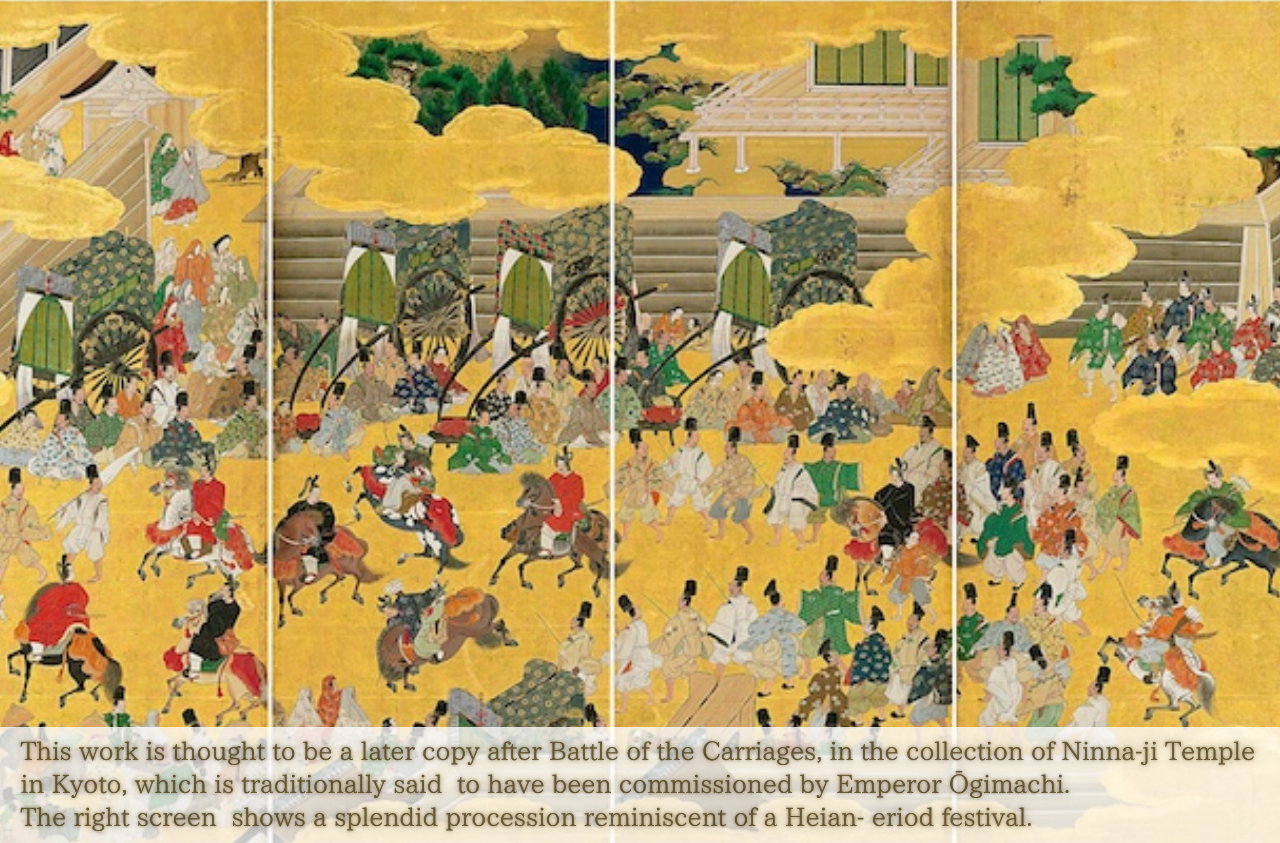
Image Source: (Excerpt from the right screen) Folding Screen with Design of the Scenes
from the Tale of Genji: Rivalry of the Carriages, 17th century
Tokyo Fuji Art Museun Collection, Japan